


Which marine animals would claim gold at the Winter Olympics?
As we enter the final few days of the 2026 Winter Olympics, we take a look at the marine animals that would be sure to steal the number one spot in the games.
Figure skating: sea angel

Credit: Kirsty Andrews
Overall, the sea angel is bound to get a near-perfect score for composition and execution.
Curling: common octopus
Needless to say, having eight arms is highly beneficial in curling – why hold one brush, when you can hold eight? As each arm has its own ‘mini-brain’, they can act independently – each arm uses sensory information to drive its movements, meaning the common octopus can quickly react to changes in the game and sense when and where to sweep the ice.
This octopus is also highly intelligent, enabling it to devise a playing strategy and slide the curling stone with accuracy. Using their jet-propulsion ability, they can shoot forward – momentum that’s required to push the heavy stone forward.
These traits, coupled with the octopus’s ability to walk and the suckers that prevent it sliding on the curling rink, are sure to secure the common octopus a win at the Winter Olympics.
If all else fails, it can use its inky defence mechanism to sabotage the competition.
Bobsleigh: blue shark

Credit: Jon Bunker
Its long, sleek appearance and the small tooth-like structures covering its skin enable the blue shark to be hydrodynamic, so it can torpedo through water (or on a bobsleigh) at top speeds.
As well as speed, teamwork is crucial to succeed in bobsleighing – something the blue shark is well suited to. Unlike most shark species, they live, hunt and migrate in groups; these are often separated by sex, just like the Olympics. Within these groups (or team), there is usually a hierarchy, with the largest shark acting as leader – it’s this leader that would jump in the front of the bobsleigh to take Team Blue Shark to the finish line in victory.
Alpine skiing: box jellyfish
Box jellyfish can have up to 15 tentacles, which are crucial to stand on the skis and hold the poles. Its cube-shaped bell acts as a built-in helmet, while its transparent blue colour means it can sneak up on its opponents unnoticed.
Unlike most jellyfish, the box jellyfish has eyes, enabling it to see. As these are spread around its bell, the jellyfish has 360-degree vision; this gives it the upper hand in skiing – it can spot the gates to slip through, the upcoming turns and where its competitors are.
Speed is everything. This species is quicker than many other jellyfish species, moving up to six metres per hour, with the ability to propel itself forward and beat the competition to the finish line.
Biathlon: archerfish
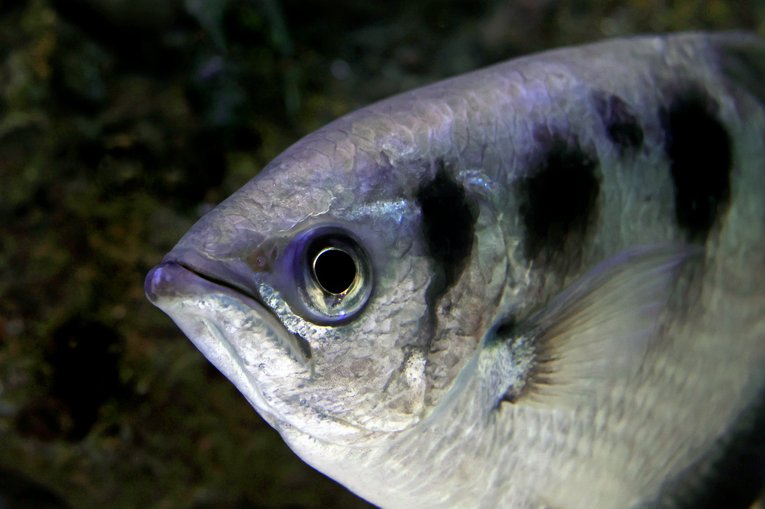
Credit: David Clode
Archerfish are famous for their almost uncanny accuracy. Known as nature’s ‘spitting sharpshooters’, these surface-dwelling fish can bring down insects perched up to 1.5 metres above the water by firing a perfectly aimed jet of water from their mouths – almost always hit their target on the very first shot.
Archerfish have specially adapted mouths with an internal channel powered by strong jaw muscles. When the fish raises its tongue, it creates a narrow tube – essentially a biological water pistol barrel – allowing it to fire a high‑pressure jet with incredible accuracy, possessing the kind of precision any biathlete could only dream of.
Ski jumping: flying fish
These remarkable ray‑finned fish, found in tropical and temperate waters, are natural high‑flyers, with some individuals capable of gliding in the air for almost one minute.
Flying fish launch themselves into the air with powerful underwater acceleration, reaching speeds of over 35mph thanks to their streamlined, torpedo‑shaped bodies. At the perfect moment, they angle upwards and burst through the surface, unfurling their distinctive wing‑like pectoral fins and soaring through the air for up to 200 metres.
This incredible natural talent makes flying fish the perfect contenders for ski jumping. If they can already glide hundreds of metres simply by breaking the surface of the sea, imagine how far they’d launch if they started with a steep downhill ski ramp and a head‑start of icy speed. With their built‑in wings, aerodynamic bodies and fearless flair for flight, these fish would soar well beyond the landing zone – and may even need their own special category.